
Commercial Applications
- Properties, History and Challenges
- Overview
- Electric Power
- Transportation
- Medical Imaging and Diagnostics
- NMR for Medical and Materials Applications
- Industrial Processing
- High Energy Physics
- Wireless Communications
- Instrumentation, Sensors, Standards and Radar
- Large-Scale Computing
- Renewable Energy
- Cryogenics: An Enabling Technology

Applications in Wireless Communications
Superconductor devices, both analog and digital, offer unique advantages for RF (wireless) applications due to ultra-low dissipation and distortion as well as intrinsic (quantum) accuracy. The U.S. Army called their new receiver chip the “most significant change to satellite communications worldwide in 30 years.” Superconductor RF filters with superior interference cancellation have been employed in cellular base stations, enabling wider range and fewer dropped calls. Fourth generation All-Digital Receivers (ADRs) for U.S. defense deliver dramatic improvements in performance, cost and efficiency for SIGINT, EW and SATCOM systems. ADRs are deployed in several government programs, addressing the most difficult national RF challenges.
HTS Filters
Cellular base stations receive relatively weak mobile signals with very sensitive antennas and receivers on many channels simultaneously. To perform this task and deal with the tremendous RF interference in the environment some systems employ superconductor RF filters that cancel much of this interference. These filters increase the range of handset due to the superior performance of these ultra-sharp filters. This technology has been commercially deployed in more than 10,000 base stations with over 400 million hours of run time. The cryogenically cooled filters have been exposed to the worse elements and proven very reliable, with Mean-Time-Between-Failure (MTBF) greater than 1 million hours. In an industry where reliability and uptime are the number one goal, these HTS filters have proven that superconductors improve our everyday life.
All-Digital Receivers
While HTS filters have demonstrated unique capabilities in analog (non-digital) RF applications, the true revolution is one that takes advantage of the intrinsic linearity and quantum accuracy of digital superconductor devices (chips) to produce the world’s highest performing analog-to-digital converters.
Much like digital CDs and digital television provide superior performance, All-Digital Receivers deliver superior performance to all wireless applications. The crux of the improvement is in the unique ability of superconducting analog-to-digital converters to digitize a wide swath of spectrum without the need for analog pre-processing. As a result, significant portions of the conventional RF system are completely eliminated, reducing size and power while significantly improving receiver sensitivity performance. In addition, the manipulation of the digital data enables unparalled flexibility in the signal processing that detects, characterizes and decodes incoming RF signals. These all-digital superconductor receivers have been successfully integrated into legacy wireless systems with the latest cryogenic cooling and systems engineering innovations. From radio astronomy to the latest electronic warfare systems, digital superconductor RF has significantly pushed the state-of-the-art.
“Most Significant Change to Satellite Communications Worldwide in 30 years”
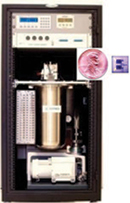 An early demonstration of the capability if superconducting All-Digital Receivers was carried out by the U.S. Army, where an X-Band satellite downlink was accomplished with a single ADR system that replaced many racks of legacy receiver components. The ability to directly digitize wideband X-Band SATCOM signals (an important military band) proved so impressive it led to the proclamation that the “most significant change to satellite communications worldwide in 30 years” had been achieved.
Today’s All-Digital Receivers are packaged in ½ of a 19-inch electronics rack, completely free of liquid cryogen and capable of being equipped to digitize multiple GHz of instantaneous bandwidth virtually anywhere from DC to “W” Band. The modular design can be customized for a variety of applications and is upgradable and programmable with relative ease.
To complement the All-Digital Receiver and address certain applications, a Cryogenic Analog RF Module (CARM) has been recently developed to provide RF amplification with extremely low noise. Initially designed for Ka-Band, the module features a compact cryogenic cooler and can be modified for a wide range of RF bands.
The heart of the All-Digital Receiver system is the superconducting integrated circuit (IC). This chip circuit is made similarly to semiconductors, but the key material is Low Temperature Superconductor (LTS) niobium vs. silicon. The chip - less than half the size of a penny - employs Josephson junctions that make up Rapid Single Flux Quantum(RSFQ) logic circuits that move picosecond-duration magnetic pulses vs. electrons. These LTS ICs need to be cooled to approximately 4 degrees Kelvin compared to 70 degrees Kelvin for analog HTS materials. New innovations in small, off-the-shelf, cryogen-free cryocoolers provide compact cooling platforms for packaging and deploying All-Digital Receivers. [1]
Issues and Recommendations
All-Digital Receivers (and accompanying Transmitters and Transceivers) have been largely developed by and for defense and other government programs with the most difficult RF challenges. Continued government program support is needed to fully exploit the performance capabilities of this technology. Most commercial RF applications are highly commoditized with very large volumes and digital superconductors are still not cost competitive for many applications that otherwise would benefit from significantly improved performance.
- [1] All-Digital Receiver on a One-Centimeter Superconducting Niobium Chip Image courtesy of Hypres, Inc..