Commercial Applications
- Properties, History and Challenges
- Overview
- Electric Power
- Transportation
- Medical Imaging and Diagnostics
- NMR for Medical and Materials Applications
- Industrial Processing
- High Energy Physics
- Wireless Communications
- Instrumentation, Sensors, Standards and Radar
- Large-Scale Computing
- Renewable Energy
- Cryogenics: An Enabling Technology

Applications in Large-Scale Computing
Low temperature superconductor technology makes possible computers with operating speed, energy efficiency and physical compactness far beyond the limits of conventional semiconductor technologies. While highly challenging, the path forward is clear. Success will enable large-scale computing to continue growing at a price we can afford.
Superconductivity has long held promise for computing due to some of its unique capabilities. Semiconductor technologies won out in the past, but seem to be hitting the wall, especially when it comes to energy usage and speed.
Transistors, the switching elements in present-day computers, are made of semiconducting materials. The problem is that a small but still significant amount of energy is dissipated when a transistor switches. Additional energy is required to transmit signals through the tiny wires that connect transistors and other circuit elements. The faster the transistors switch, the greater the power loss. Processor chips recently hit cooling limits, causing computer engineers to stop increasing the operating frequency as had been planned. The number of processors working in parallel has been increased in attempt to make up the shortfall, but this approach makes programs harder to develop and often results in poor processor utilization.
Energy cost is now a significant and growing portion of life-cycle cost for large computing systems such as server farms, data centers and supercomputers. Drivers for the increase include increased internet traffic, movement to cloud computing supported by large computers, and the increasing demands for capability computing in the scientific, technical and financial areas. How big is the problem? As an example, Facebook’s data center in Prineville, Oregon used in 2013 the electrical energy required by about 20,000 U.S. homes. Building such large data centers and supercomputers is already challenging and yet the demand for data and computing continues to grow.
Superconducting computing offers a solution, but requires development.
The Josephson Junction is a type of switch unique to superconductors. A weak link between two superconductors allows a small current to pass with no voltage drop or energy dissipation. Increasing the current above the critical current causes the junction to switch and output a single flux quantum (SFQ). The switching speed is on the order of a picosecond, much faster than semiconductor transistors. The switching energy is also thousands of times smaller. Clock speeds of hundreds of gigahertz have been demonstrated in superconducting logic circuits. New types of SFQ logic circuits have greatly decreased the energy required per computation.
Interconnects between superconducting circuit elements can be provided by superconducting passive transmission lines, which dissipate almost no energy. These connections are also quite fast—pulses made up of single or multiple flux quanta propagate along the transmission lines at about one third the speed of light in a vacuum.
Memory is also required in computers. A small loop of superconductor can contain only an integer number of flux quanta. No flux quanta within the loop is commonly taken as a ‘0’ in digital logic. Making small loops with sufficient inductance has been a challenge that might be overcome by adapting technologies already developed for producing semiconductor circuits with smaller sizes. Other memory or inductive elements uniquely enabled by superconductivity are also in development and may provide greater physical density.
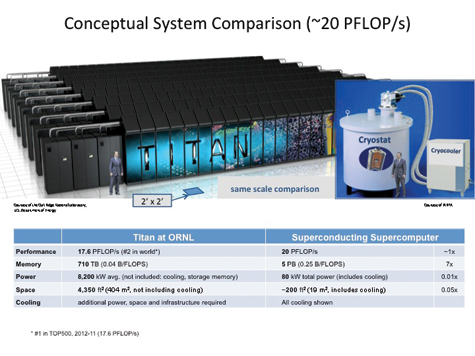
New logic, interconnects, and memory with capabilities very different from conventional technologies will allow new computer architectures and capabilities. Development of superconducting computers is already underway. An example is the IARPA Cryogenic Computing Complexity (C3) program which seeks to develop the required technologies and then integrate those new technologies into a superconducting computer. The picture shows how a concept superconducting computer would compare to a conventional supercomputer.
Quantum computing is another potential application of superconductivity, although further in the future. Unlike conventional digital data bits which exist in only two states—either ‘1’ or ‘0’—quantum bits can hold a mix of states and can be used to solve some problems much faster than conventional digital computers.
Developing superconducting computing technology will require people with both new ideas and the ability to make them work.