
Commercial Applications
- Properties, History and Challenges
- Overview
- Electric Power
- Transportation
- Medical Imaging and Diagnostics
- NMR for Medical and Materials Applications
- Industrial Processing
- High Energy Physics
- Wireless Communications
- Instrumentation, Sensors, Standards and Radar
- Large-Scale Computing
- Renewable Energy
- Cryogenics: An Enabling Technology

Applications in Transportation
Around the world, transportation systems are facing unprecedented new challenges. Pressures on the systems and technologies that move people and goods will continue to intensify due to several factors: rising demand; changes in fuel market economics; emissions and evironmental issues; and the demand for improved system performance. In response, most modes of transportation are being electrified. Superconductivity can leverage the advantages of electrified transportation of various types, ranging from high-speed trains to advanced ship propulsion systems and lighter weight aircraft engines. The incorporation of superconductor technology into transportation system design can improve the efficiency and performance, reduce the size, weight and fuel consumption and extend the range of transportation systems of all types.
Transportation at a Crossroads
 Around the world, today’s transportation systems are facing an unfolding crisis. Nearly all of the dominant technologies that provide mobility today - including automobiles, trains, ships and aircraft - depend overwhelmingly onpetroleum-based fuels. Yet, world oil prices continue to rise, and low-cost oil supplies are dwindling. Modern societies, which depend on a high level of mobility, face the prospect of higher costs and concomitant slower economic growth if new solutions to assure the movement of passengers and goods are not available.
One of the most promising responses to this challenge lies in the electrification of transportation. Electrification allows for the powering of many transportation systems from the interconnected power grid and the inherent efficiency of electric drive systems can also result in significant cost savings.
 In many ways, the electrification of transportation is an old story. In the late 19th century, electric streetcar systems literally provided the incentive to electrify urban neighborhoods. Through the mid-20th century, many developed nations adopted
high-speed electric trains. However, the rise of low-cost oil in the early 20th century
encouraged the migration away from grid-based systems to the adoption of alternatives
that offered greater convenience and flexibility. In the 21st century, electricity is getting a new look as the basis for powering transportation systems. Factors driving interest in
electrification of transportation include both the performance advantages of electric
systems as well as the increasing cost and tightening supply of oil.
In many ways, the electrification of transportation is an old story. In the late 19th century, electric streetcar systems literally provided the incentive to electrify urban neighborhoods. Through the mid-20th century, many developed nations adopted
high-speed electric trains. However, the rise of low-cost oil in the early 20th century
encouraged the migration away from grid-based systems to the adoption of alternatives
that offered greater convenience and flexibility. In the 21st century, electricity is getting a new look as the basis for powering transportation systems. Factors driving interest in
electrification of transportation include both the performance advantages of electric
systems as well as the increasing cost and tightening supply of oil.
Today’s innovations are adapting electric technology in ways that combine the advantages of stand-alone transportation systems with the cleanliness, efficiency and convenience of electricity. Prominent land-based examples of today’s cutting-edge mobility innovations include rechargeable, plug-in hybrid cars, super high-speed magnetically levitated trains and intercity trains with more efficient traction transformers. All of these transportation systems could be powered by a wide range of energy sources through the power grid. Meanwhile, at sea, ship propulsion is also being electrified, employing self-contained systems for the efficient production and delivery of power on board large vessels.
The Role of Superconductivity
Superconductivity offers several ways to leverage the benefits of electrification in many of these transport applications. High-performance, lightweight superconductor technologies can make transportation propulsion systems more powerful yet smaller and lighter. The following capsule descriptions explain how superconductivity is being applied in a variety of transportation technologies to ensure that society continues to enjoy mobility in a resource-constrained world.
HTS Ship Propulsion: A Revolution in Ship Design
 Within the past 20 years, ship designers have begun to adopt electric propulsion systems. This shift has been characterized as the most important change in ship design since the adoption of diesel engines in the 1920s. Electric propulsion systems enable new, more flexible arrangements and the more efficient integration of a ship’s energy-using systems,
because they allow the same power plant to support propulsion as well as other
requirements. As a result, ships can be redesigned to provide more space below
deck, whether for passengers, cargo or, in the case of naval applications, weapons and
weapon systems. Among large commercial ocean-going vessels, nearly 100% of all new
ships are electrically propelled, including many large cruise ships, such as the Queen Mary 2. Electric propulsion offers other advantages for naval applications, and in 2000, the U.S. Navy announced that it would migrate toward an all-electric fleet.[1]
Within the past 20 years, ship designers have begun to adopt electric propulsion systems. This shift has been characterized as the most important change in ship design since the adoption of diesel engines in the 1920s. Electric propulsion systems enable new, more flexible arrangements and the more efficient integration of a ship’s energy-using systems,
because they allow the same power plant to support propulsion as well as other
requirements. As a result, ships can be redesigned to provide more space below
deck, whether for passengers, cargo or, in the case of naval applications, weapons and
weapon systems. Among large commercial ocean-going vessels, nearly 100% of all new
ships are electrically propelled, including many large cruise ships, such as the Queen Mary 2. Electric propulsion offers other advantages for naval applications, and in 2000, the U.S. Navy announced that it would migrate toward an all-electric fleet.[1]
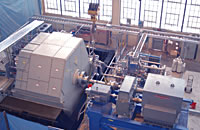 The large size and heavy weight of conventional copper-based electrical propulsion motors and generators has been a barrier to broad adoption of electric propulsion. For
these reasons, superconductors offer additional, important advantages for
electrically propelled ships. HTS motors and generators are much smaller and lighter;
operating prototypes are one-third the size and weight of their conventional copper-wound
counterparts and quieter. The elimination of rotor losses results in much higher efficiency,
especially under partial-load conditions, where many ships operate for the great majority of
their operating hours.[2]
The large size and heavy weight of conventional copper-based electrical propulsion motors and generators has been a barrier to broad adoption of electric propulsion. For
these reasons, superconductors offer additional, important advantages for
electrically propelled ships. HTS motors and generators are much smaller and lighter;
operating prototypes are one-third the size and weight of their conventional copper-wound
counterparts and quieter. The elimination of rotor losses results in much higher efficiency,
especially under partial-load conditions, where many ships operate for the great majority of
their operating hours.[2]
This improved efficiency translates into a longer cruising range and greater fuel economy. Smaller motor assemblies could also enable electric ships to use more shallow ports, and could be incorporated directly into steerable pod-based assemblies, resulting in greater flexibility and improvedmaneuverability. Smaller propulsion motors translates into naval ships that can carry more powerful weapons such as high power combat radars and additional missiles. These advantages have garnered significant interest from the U.S. Navy and other navies around the world. Apart from naval and cruise ship applications, other possible applications include many other ship types, including LNG tankers, product tankers, ferries, research ships, cable layers and icebreakers.
HTS Degaussing Coils
Another new demonstration of HTS capabilities is under way, using specially designed HTS cables to replace the copper degaussing coils on military ships. The advantages of less weight and size, coupled with high current density, make HTS cables an ideal solution for protection of military vessels.
Magnetically Levitated Trains
.jpg) Several countries in Europe and Asia rely heavily on rail transport to carry large numbers
of passengers. For longer haul express routes, rail transportation has the advantage over
air travel as it typically operates from a transportation hub in the city center. Magnetically levitated trains, employing superconducting magnets, offer a way to make trains literally “fly” to their destination by using powerful magnets to cause them to float above their guide way, or track. Magnetically levitated trains have attained top speeds in excess of 500 kph. Some transportation experts believe that maglev transportation could revolutionize transportation in the 21st century in much the same way that airplanes revolutionized 20th century transport. Superconductor magnets are essential to this application because of their dramatically lighter weight and lower power requirements.
Several countries in Europe and Asia rely heavily on rail transport to carry large numbers
of passengers. For longer haul express routes, rail transportation has the advantage over
air travel as it typically operates from a transportation hub in the city center. Magnetically levitated trains, employing superconducting magnets, offer a way to make trains literally “fly” to their destination by using powerful magnets to cause them to float above their guide way, or track. Magnetically levitated trains have attained top speeds in excess of 500 kph. Some transportation experts believe that maglev transportation could revolutionize transportation in the 21st century in much the same way that airplanes revolutionized 20th century transport. Superconductor magnets are essential to this application because of their dramatically lighter weight and lower power requirements.
A landmark commercial application of superconducting maglev technology is underway in Japan that could transform mobility in modern societies. Japan has conducted research and development on superconducting maglev since the 1960s and has produced breakthrough designs and prototypes. Since 1997, the Central Japan Railway Company (JRC) has deployed and tested a superconducting maglev (SCMAGLEV) in Yamanashi prefecture.
Using low temperature superconducting (LTS) magnets made of niobium-titanium alloys, the JRC SCMAGLEV is the fastest train in the world, achieving a speed record of 581 kph (361 mph) in 2003. On-board LTS magnets and ground coils embedded in the walls of a U-shaped guide-way provide levitation, propulsion and guidance. After traveling 850,000 kilometers at Yamanashi, the test site is now being expanded and will be part of a full revenue line. Superconductor magnets are the key enabling technology for this latest major advance in transportation systems. Also, there is now research underway on the application of HTS coils to maglev trains, which could result in lower cooling costs and higher stability.
- [1] Cruise Ship. Image courtesy of American Superconductor.
- [2] 36.5 MW HTS Ship Drive Motor. Image courtesy of American Superconductor.